How I Studied for the Claude Certified Architect Certification

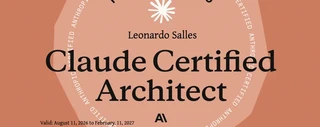
Recently, I started studying for the Claude Certified Architect — Foundations certification.
I wanted to write a short post about how I prepared, because sometimes the hardest part is not finding material. The hardest part is creating a routine and staying consistent enough to finish it.
My average study time was around 2 hours per day.
Nothing crazy. No magic plan. Just showing up almost every day, reading, reviewing, testing ideas, and trying to connect the concepts with things I already use in real projects.
That consistency helped a lot.
When you study a topic like Claude, agents, tools, MCP, context management, and reliability, it is easy to feel that everything is important at the same time. Studying a little bit every day made the content easier to digest. Some days I understood a lot. Some days I only reviewed notes and fixed gaps. But the important part was keeping the rhythm.
One thing that was harder than I expected was understanding what Anthropic really prioritizes.
It is not only about knowing how to call an API or how to write a prompt. A big part of the mindset is about building reliable AI systems: clear instructions, safe tool use, good context design, structured outputs, evaluation, and knowing when the model should or should not take action.
At first, some of these topics felt too abstract. But after reviewing examples and thinking about real use cases, they started to make more sense. The certification is not only testing if you know Claude features. It also pushes you to think like someone designing an AI solution for production.
To keep my study organized, I used this repository as a guide:
paullarionov/claude-certified-architect
The repo contains study materials for the Claude Certified Architect — Foundations certification, including guides, PDFs, EPUB files, practical tests, and Anki decks. I used it mostly to follow a clear study path and avoid jumping randomly between topics.
My flow was simple:
- Read one section at a time.
- Take quick notes in my own words.
- Review the practical questions.
- Go back to the topics where I felt weak.
- Try to connect each concept with something I would build in a real project.
For me, the last step was the most useful one. Memorizing is not enough. If the topic is about tool use, I ask myself: how would I design this tool? If the topic is about context, I ask: what should be included, and what should be removed? If the topic is about reliability, I ask: how would I know this system is working correctly?
That made the study more practical.
A short note about access
One important detail: to access the Claude Certified Architect certification, you currently need to be part of the Claude Partner Network.
The short version is:
- Go to claude.com/partners.
- Apply to join the Claude Partner Network.
- If your company is already a partner, use the Partner Portal login.
- After you have partner access, go to the certification area through Anthropic Academy / partner training.
- Request access to the Claude Certified Architect — Foundations course and exam.
After approval you will be able to apply at Skilljar’s website and take the assessment.
What I learned from the process
The biggest lesson for me was that consistency beats intensity.
Studying 2 hours per day sounds simple, but doing it for several days is what makes the difference. It gives your brain time to connect ideas, especially when the subject is not only technical, but also architectural.
The second lesson is that AI architecture is not just about prompts.
Prompts matter, of course. But good AI systems also need clear boundaries, good tool design, useful context, evaluation, fallback behavior, and a strong understanding of the user’s goal.
That is the part I enjoyed the most.
The certification helped me look at Claude not only as a model, but as part of a bigger system. And that is the mindset I want to keep improving.
